Tanning Bed Use Before Age of 30 Ups Risk of Melanoma by 75%.

When I heard the headline "Tanning bed use before age of thirty ups risk of deadliest form of melanoma by 75%", I got scared and then investigated.

I had a tanning bed in my bedroom in my twenties. Being a bit, ahem, older now, I realize the damage of UVA/UVB rays. I use sunscreen and am a faux-tan (self-tanning) pro. But the damage is done, and I know now how important it is to keep up my regular skin care check-ups with a dermatologist. At the same time, I cannot preach enough about the dangers of tanning beds.


Here is the article:

LONDON (AP) — International cancer experts have moved tanning beds and other sources of ultraviolet radiation into the top cancer risk category, deeming them as deadly as arsenic and mustard gas.

For years, scientists have described tanning beds and ultraviolet radiation as "probable carcinogens."

A new analysis of about 20 studies concludes the risk of skin cancer jumps by 75% when people start using tanning beds before age 30. Experts also found that all types of ultraviolet radiation caused worrying mutations in mice, proof the radiation is carcinogenic. Previously, only one type of ultraviolet radiation was thought to be lethal.

The new classification means tanning beds and other sources of ultraviolet radiation are definite causes of cancer, alongside tobacco, the hepatitis B virus and chimney sweeping, among others.

The research was published online in the medical journal Lancet Oncology on Wednesday, by experts at the International Agency for Research on Cancer in Lyon, the cancer arm of the World Health Organization.

"People need to be reminded of the risks of sunbeds," said Vincent Cogliano, one of the cancer researchers. "We hope the prevailing culture will change so teens don't think they need to use sunbeds to get a tan."

Most lights used in tanning beds give off mainly ultraviolet radiation, which cause skin and eye cancer, according to the International Agency for Cancer Research.

The classification of tanning beds as carcinogenic was disputed by Kathy Banks, chief executive of The Sunbed Association, a European trade association of tanning bed makers and operators.

"The fact that is continuously ignored is that there is no proven link between the responsible use of sunbeds and skin cancer," Banks said in a statement. She said most users of tanning beds use them less than 20 times a year.

But as use of tanning beds has increased among people under 30, doctors have seen a parallel rise in the numbers of young people with skin cancer. In Britain, melanoma, the deadliest kind of skin cancer, is now the leading cancer diagnosed in women in their 20s. Normally, skin cancer rates are highest in people over 75.

Previous studies found younger people who regularly use tanning beds are eight times more likely to get melanoma than people who have never used them. In the past, WHO warned people younger than 18 to stay away from tanning beds.

Copyright 2009 The Associated Press. All rights reserved. This material may not be published, broadcast, rewritten or redistributed.

------------

In other words - SAY NO TO TANNING BEDS! If you did expose yourself to these harmful rays, be sure to get yearly check-ups and see your doctor at the first sign of finding any type of suspicisous looking spot or mole on your body.

Click for my top sunscreen and self-tanning recommendations.

Cogliano cautioned that ultravoilet radiation is not healthy, whether it comes from a tanning bed or from the sun. The American Cancer Society advises people to try bronzing or self-tanning creams instead of tanning beds.
If I Could Turn Back Time...

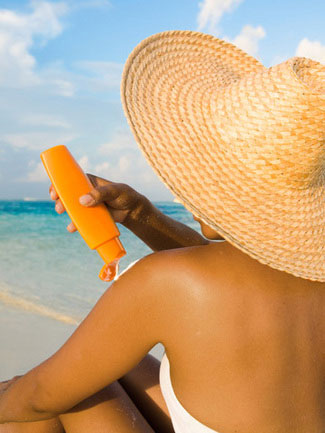
Simply said, if I could turn back time, I would wear a high SPF each and every day and never burn my skin to a crisp while laying in the sun. Especially as a young teen. Slicking on the baby oil to get burnt to get a dark tan; it almost makes me sick now to think what I put myself through. Besides the risk of skin cancer, which was never talked about in the 80's and 90's, I should have known better than to pre-age my skin.

I still love to sit in the sun, go to the beach and play in the pool. I crave warmth of the sun on my skin and the extra boost of Vitamin D. But I wear a high SPF, usually 30 or 45. At the beach, except for being in the water, I am stationed under an umbrella. I wear a wide rimmed hat and large sunglasses. I think if I had done these things from the start, I would not be dealing with the sun damaged skin that I am dealing with now.

My freckles and age spots are out of control. My dermatologist says that my hyper pigmentation is more of a hormone issue, while the onslaught of freckles and larger spots is definitely due to all of the time I previously spent in the sun without sunscreen.

Dr. Jeffrey Dover, Associate Clinical Professor of Dermatology, at Yale University School of Medicine and author of THE YOUTH EQUATION recently sent over some great sunscreen advice.

Dr. Dover said that while most people now recognize the direct link between sun exposure and skin cancer, many are confused over which SPF products really protect them. This even prompted the FDA to revaluate the way the industry labels its sunscreens. Dr. Dover recommends wearing at least SPF 15 when spending minimal time outside and SPF 30 or higher when outside for longer or if living in the south.

According to Dr. Dover, only formulas labeled “broad spectrum” guard against both UVA and UVB rays.

Some of his favorites include:

  • La Roche-Posay Anthelios 40 Sunscreen Cream with Mexoryl SX - $32
  • Neutrogena Ultra Sheer Dry-Touch Sunblock with Helioplex, SPF 55 and 70 - $9.49 - $11.99
  • skin effects by Dr. Jeffrey Dover Continuous Action Spray Sunscreen SPF 45 with DermaplexTM which contains less chemical sunscreens and remains effective for up to five hours - $12.99

High-quality sunscreens are part of the equation, but being fully protected also means re-applying often. Ideally, you should coat every exposed patch of skin with a thick layer of sunscreen,and continue to reapply it every few hours you remain outside (apply more often after sweating or swimming).

“If at the end of the summer you’re still squirting from the same tube that you bought before Memorial Day weekend,you need an education in application,” says Dover, who suggests about one ounce (or a full shot glass) of sunscreen to cover your entire body.

All of the products Dr. Dover mentioned are conveniently available at your local CVS/pharmacy, so you don’t need to travel far for cost-effective and accessible sun protection. The main point is to wear it.

Have a Wonderful Sun-Safe Weekend!

I have had a horrendous week and I cannot believe I did not have a chance to get much posted at all. I am so sorry about this. I usually have posts in queue in case something like this past week happens, but I guess it goes to show just how busy I have been that I had nothing prepared when life threw us a little curve.

Alas, it is the weekend. A long weekend for most of us. The first "unofficial" weekend of summer. As we  all prepare to head outside more and more, I thought it was appropriate to send out another little reminder on how important sunscreen is.

You need to use sunscreen. Daily. I know it is hard and I admit I don't use it everyday except for on my face. But in the spring and summer when I plan on spending alot of time outside, I do use it and apply it before getting dressed. Not only does wearing sunscreen help prevent skin cancer, it protects you from the rays that make you look older, faster. If that is not reason enough, than I don't know what is.

Sun and Sunscreen tips:

  • Use a sunscreen that is factor 15 or over for adequate protection from UV.
  • Reapply sunscreen throughout the day.
  • Go into the shade between 12 noon and 3pm, as this is when the sun is at it's most damaging.
  • Don't binge tan (sunbathing for intense periods). A tan will build up gradually through normal sun exposure.
  • Don't intentionally try to get burnt - a lot of young people believe that burning = tanning. But sunburn is not necessary for your skin to get a tan.

Here is a look back at some of my favorite sunscreen, after-sun products and the healthy alternatives of self-tanner:

My everyday sunscreen of choice

Just in case you get burned

Repair and soothe

One of my favorite self-tanning lines

Look like you spent the weekend in the Mediterranean

Enjoy the weekend!